
Dental Bridge in Denver, CO
A bridge connects what was once divided. It restores the ease of movement, the sense of wholeness that comes when two sides meet again. In dentistry, that same idea takes shape in a different way. When a tooth is lost, the gap it leaves behind affects how you eat, how you speak, and how your smile feels. A dental bridge rebuilds that connection, returning balance to the simple moments that make up your day.
At Donald Rice, DDS, we approach every restoration with care and precision. Each bridge is planned to fit comfortably, function naturally, and look like it’s always belonged. Our focus is on rebuilding that sense of completeness, so your smile feels strong, steady, and entirely your own.
What Is a Dental Bridge?
A dental bridge fills the space where teeth are missing by anchoring an artificial tooth to the natural teeth or dental implants beside the gap. If you’ve lost one or more teeth in a row, a dental bridge can restore both the look and function of your smile.
Types of Dental Bridges
We offer various types of dental bridges, allowing us to tailor your treatment to your needs and preferences:
| Type | Supported by… | Benefits | Ideal for… |
|---|---|---|---|
| Traditional | Dental crowns on the healthy teeth on each side of the gap | Excellent choice for replacing molars due to their durability | Patients with healthy teeth on both sides of the gap |
| Cantilever | A dental crown on a healthy tooth on just one side of the gap | Placement only affects one healthy tooth | Patients with a healthy tooth on one side of the gap |
| Maryland | A metal or porcelain framework that connects the false tooth to the back of the adjacent teeth | Less invasive placement (most conservative option) | Replacing front teeth where chewing forces are low |
| Implant-Supported | Dental implants secured in the jawbone where the teeth are missing | Remarkably stable and durable, providing long-term outcomes | Patients without healthy neighboring teeth or those seeking the most durable replacement option |
The Dental Bridge Procedure
Placing Traditional, Cantilever, and Maryland Bridges
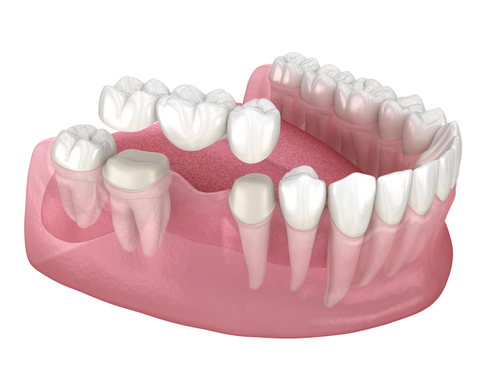
While all dental bridges share the goal of filling in the space where teeth are missing, the specific procedure depends on the type of bridge you need. Because traditional and cantilever bridges are supported by healthy teeth next to the gap, we start the procedure by preparing these teeth for dental crowns. A dental crown encapsulates the entire tooth, so we need to make space for the crown by removing some of the tooth enamel. This process allows the bridge to fit snugly. After we shape the anchor teeth, we will take impressions so that your custom bridge can be fabricated. We’ll attach a temporary bridge in the meantime to protect the area and maintain aesthetics. When you come in a few weeks later, we will replace the temporary bridge with your final restoration.
Unlike traditional and cantilever bridges, Maryland bridges require little tooth preparation. When you come in for your first visit, we’ll take impressions so the dental lab can create your bridge. When it is ready, we will check that your custom bridge fits perfectly. Then, we will bond the metal or porcelain wings of the bridge to the back of the adjacent teeth. To do this, we will apply an etching solution to ensure the bridge will adhere to the tooth. We then use strong dental cement to attach the bridge.
Placing an Implant-Supported Bridge
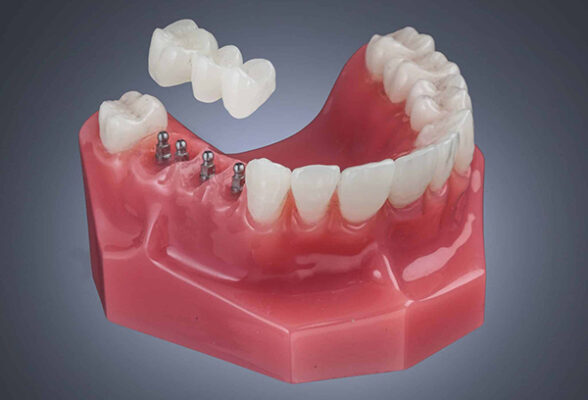
Implant-supported bridges take a few extra steps because they rely on implants instead of natural teeth for support. Dr. Rice will begin by placing the implants into your jaw to create a secure foundation for your bridge. For traditional implants, he will make a small incision in your gums before inserting the implant screw.
With mini dental implants, he will simply create a pilot hole through the gum tissue and place the implant directly. As your implants heal, you may be fitted with a temporary bridge, allowing you to speak and eat comfortably during this stage. Once healing is complete, Dr. Rice will attach your custom bridge to the implants, restoring your smile with strength and lasting stability.
A Dental Bridge and Partial Dentures: Which Option Fits You?
Many patients ask about the difference between dental bridges and partial dentures since both options replace multiple missing teeth. The main distinction is that a dental bridge is fixed in place, while a partial denture can be removed. A bridge consists of a row of artificial teeth supported by either natural teeth or dental implants. A partial denture, on the other hand, features a gum-colored base that supports the replacement teeth and a lightweight acrylic or metal framework that clips onto nearby teeth for added stability.
Because a bridge stays securely in place, it offers greater stability and a more natural feel when you eat and speak. It is also easy to care for, as you can brush and floss it much like your natural teeth. However, it is still important to clean carefully around the bridge to prevent bacteria from accumulating near the supporting teeth.
Some patients prefer removable partial dentures because they can remove them for cleaning, making maintenance simpler. Partial dentures are often a more affordable option, especially when multiple teeth are missing in different areas of the mouth. However, they may shift slightly during meals or conversation, which can affect comfort and function over time.
Ultimately, the right choice depends on your oral health, budget, and personal preference. During your consultation, Dr. Rice will evaluate your needs, explain your options, and help you decide which solution best restores your smile.
Bridge the Gap in Your Smile at Donald Rice, DDS
At Donald Rice, DDS, we take the time to understand what matters to you and design a solution that feels right, functions reliably, and fits naturally. If you’re living with missing teeth, now is the right time to reconnect with the comfort and stability you deserve. Contact us today to schedule a consultation and discover how a dental bridge can help restore what you’ve been missing.
Frequently Asked Questions
Following tooth loss, it’s important to replace the missing teeth promptly. A dental bridge (no matter the type) prevents neighboring teeth from drifting toward the empty space. Acting as a barrier, the bridge keeps the rest of your teeth in their proper positions, maintaining your bite alignment. The bridge also distributes your bite forces evenly, preventing excess pressure from being placed on the remaining teeth. In addition to improving chewing and biting, bridges help you pronounce words more accurately, enhancing overall speech clarity.
Implant-supported bridges offer additional advantages since the implant screw replaces the lost tooth roots. This is important because the tooth roots stimulate the jawbone, keeping it healthy and strong. An implant bridge is also the most stable option, given that the restoration connects to dental implants that fuse with your jaw. This unmatched reliability makes implant-supported bridges the gold standard for replacing multiple teeth in a row.
Ideal candidates for an implant-supported bridge are individuals in good general health who have sufficient bone to accommodate the implants. Without the proper bone density and volume, the risk of implant failure is high.
Before recommending dental implants, Dr. Rice will evaluate your eligibility using digital X-rays that give us insight into the condition of your jawbone. If your jawbone lacks the proper qualities for implant treatment, we may recommend bone grafting or another tooth replacement option, such as a traditional bridge.
Dental bridges last up to 15 years or longer with proper care. However, the type of bridge used can affect longevity. For instance, Maryland and cantilever bridges tend to need replacement earlier than traditional bridges, and implant-supported bridges typically last the longest.
With any dental bridge, consistent care and maintenance are essential for prolonging the lifespan of the restoration. Here’s what we recommend:
- Brush twice daily with a soft-bristled toothbrush.
- Clean around and under the bridge. A water flosser is a great tool for cleaning hard-to-reach areas.
- Use fluoride mouthwash to keep your gums healthy and prevent bacteria accumulation.
- Avoid chewing on ice or using your teeth as tools.
- Visit our office every six months for professional cleaning services.