
Implant Dentures in Denver, CO
Food plays a crucial role in our interactions with others. Whether you’re sitting down with loved ones to share a meal or passing down a recipe through generations, eating is a form of connection! But when you struggle to chew, it can sometimes feel like you’re disconnected from everyone else around you. Missing teeth make it difficult to break down foods, often restricting what you can eat. While traditional dentures replace missing teeth, they lack the stability of your natural smile. Foods like corn on the cob, steak, and even nuts are typically off-limits for those with loose dentures. Fortunately, implant dentures offer a more stable solution for tooth loss. With dental implants supporting your smile, you’re able to enjoy all the foods you love again without hesitation!
Why Do Dentures Loosen Over Time?
Traditional dentures are custom-fit to the contours of your mouth, resting perfectly on your gums. However, this fit isn’t made to last.
Natural teeth have roots that extend into your jawbone, both keeping your smile secure and also stimulating your bone. Bone stimulation is necessary to keep your jaw full and healthy!
Unfortunately, traditional dentures don’t have tooth roots, allowing your bone to lose mass and volume over time. A shrinking jawbone makes a poor foundation for your dentures, causing the prosthetic to lose its perfect fit.
Loose dentures create a whole host of problems, including:
- Difficulties speaking: To speak any language, you need the use of your teeth and tongue. With loose dentures, speaking clearly becomes a challenge, disrupting your ability to communicate effectively.
- Painful denture sores: As your denture base slides around on your gums, it irritates the tissues there. Irritated gums then turn into denture sores, which are painful lesions that make wearing your dentures difficult.
- Challenges chewing: To chew effectively, you need to break down foods into smaller pieces that are easier to digest. But with loose dentures, it’s almost impossible to eat tougher foods. Many patients have to limit their diets to soft foods, missing out on important nutrients.
Fortunately, dental implants help anchor your denture to your jaw, securing your smile in place and replacing your missing tooth roots. With implant dentures, patients like you can enjoy a healthy and functional smile!
How Implant Dentures Secure Your Smile
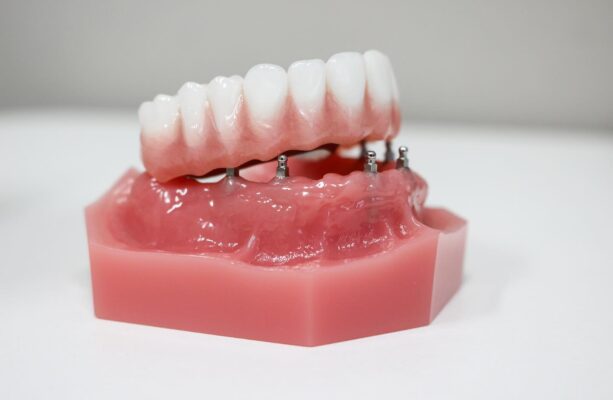
Dental implants are titanium posts that secure in your jawbone to replace missing tooth roots. Not only do these screws help secure restorations, but they also act as artificial tooth roots, stimulating your bone to keep your jaw secure.
Then, with your implants in place, Dr. Rice will attach your denture restoration to restore your smile! However, Donald Rice, DDS, uses two types of dental implants.
Conventional dental implants are large and require a lot of jawbone structure to place. Mini dental implants, in contrast, are much smaller, fitting even in minimal bone. While Dr. Rice places both types of implants, he often prefers mini dental implants due to the incredible benefits they provide.
Thanks to their sleek structure and design, these titanium posts are faster healing than conventional implants, just as effective, and half the cost.
The Implant Denture Process
To begin your implant treatment, Dr. Rice always starts with a free consultation.
Here, he will assess your jawbone, examine your teeth, and discover if you’re eligible for implants. While bone loss is common among those with missing teeth, mini implants are able to fit into minimal bone! Conventional implants usually require additional procedures to rebuild lost bone, but mini implants typically allow patients to skip these bone augmentation procedures!
Once he determines you’re eligible, he will create a treatment plan for your smile and schedule your placement appointment.
During your procedural visit, Dr. Rice will use a local anesthetic to numb the treatment area. Then, he’ll make a small pilot hole in your gums and jaw, and gently place a mini implant inside, where it will immediately begin to stabilize. Thanks to their biocompatible design, dental implants integrate with your bone, creating a remarkably strong connection. Then, using the stable connection as a base, Dr. Rice secures your denture to your implants, anchoring your smile in place.
While your implants need a few weeks of healing before supporting a final denture, Dr. Rice will provide you with a temporary prosthetic to maintain the function and aesthetic of your smile.
Mini Implant Dentures at Donald Rice, DDS
Donald Rice, DDS, offers three distinct mini implant denture models to choose from.
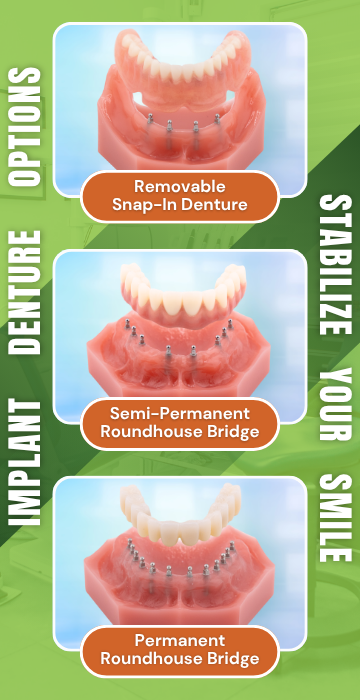 Overdentures: Similar to traditional dentures, overdentures have a gum base that rests on your gums and bone. However, they also rely on mini dental implants for support, as these titanium posts anchor the denture in place. Thanks to their special O-ring design, you can remove the denture as needed for routine maintenance and snap it back in when you’re done.
- Semi-permanent dentures: A roundhouse bridge is a type of denture that is sleek, requiring less of the denture base associated with traditional dentures. Instead, it features a sleek horseshoe-like design that follows the curve of your jawbone. By placing dental implants in your jaw to secure it in place, Dr. Rice provides a secure smile that allows you to eat more of the foods you love. While your prosthetic remains on your implants most of the time, we will need to remove it for routine dental cleanings.
- Permanent dentures: Similar to a semi-permanent denture, this prosthetic is a roundhouse bridge that provides a natural-looking solution to tooth loss. However, a permanent restoration is cemented in place, providing a natural feel as well. With implants anchoring your smile to your jaw, you can forget about dietary restrictions and enjoy all your favorite foods again!
Enjoy the Foods You Love Again With Implant Dentures!
Eating meals with those you love is an important part of the social connection that we all need. However, with loose dentures or missing teeth, enjoying food becomes a struggle, often causing a disconnect between you and others. To stay connected, Dr. Rice encourages patients to consider implant dentures. These restorations both keep your smile in place but also restore your ability to eat and speak without hesitation!
Book a free implant consultation to learn if you’re eligible for treatment, and discover which denture is right for your smile.
Frequently Asked Questions
The cost of implant dentures depends on a few different factors.
The most important, of course, is the type of denture prosthetic you choose. Overdentures are the least expensive, as they use the fewest number of implants for support. Permanent dentures require more implants and are therefore more expensive.
While your insurance may cover part of the denture prosthetic, it often doesn’t cover dental implants. Fortunately, Dr. Rice partners with multiple third-party financing companies to help ease your financial burden! With these flexible financing options at your disposal, you can split your costs into manageable monthly payments.
To learn what your implant denture treatment will cost, come in for a free implant consultation. There, Dr. Rice will go over the pricing for your treatment and discuss financing options with you.
Implant dentures are meant to last you a lifetime, but only if you take care of them. Just like your natural teeth, implant dentures need to be brushed and flossed daily!
To brush your teeth properly, Dr. Rice recommends using a denture-safe toothpaste and a soft-bristle brush. Make sure to gently brush at least twice a day, and clean the area around your implants on your gums. If you have a removable denture, it’s easier to clean thoroughly because you can remove it as necessary, including after meals. With a permanent denture, treat the prosthetic like your natural teeth.
By maintaining a proper oral hygiene routine and attending professional cleanings twice a year, your dentures should last for years to come.
Overdentures, also known as snap-on dentures, are removable. To take out the upper prosthetic, gently push the back ends of your denture downwards until they “snap” off your O-rings. To remove the lower denture, push upward on the front of your prosthetic.
Once your denture is free, you can rinse it off between meals, brush it daily, and use a water flosser to reach the hard-to-reach areas of your smile that can harbor bacteria. Be sure to clean your gums as well, especially around your implants.
Then, when you’re done with denture maintenance, simply “snap” the prosthetic back in place and enjoy a stable smile.